

With increasing demand for aluminum and other products around the world, Ball remains focused on sustaining a consistent supply, while mitigating associated environmental, social, and governance impacts. More than 10,000 companies supply goods and services to Ball making it one of the most complex, diverse, and global supply chains. Ball maintains continuous dialogue with its suppliers as we collaborate to reduce potentially negative impacts and achieve common goals pertaining to circularity, climate, resource efficiency, material health, diversity and inclusion, and other relevant sustainability areas.

ASI CERTIFICATION
The Aluminum Stewardship Initiative (ASI) is an industry led initiative to drive sustainability across the entire aluminum value chain by enabling producers and users of aluminum to demonstrate responsible production and sourcing practices. ASI is comprised of two standards – the Performance Standard and the Chain of Custody Standard – and are the basis of the ASI certification program.
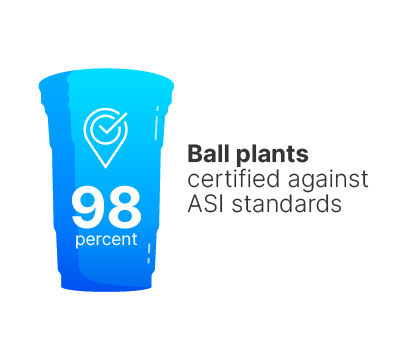
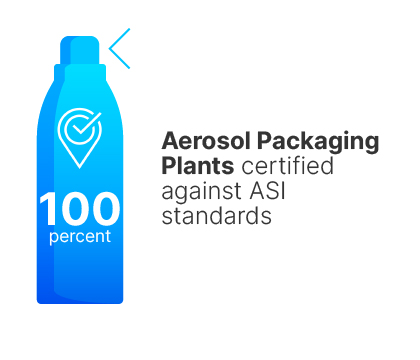
Ball joined ASI in 2012 and, in conjunction with NGOs and industry partners, crafted the ASI standards which were launched in late 2017. In 2022, Ball became the first beverage can manufacturer to certify all of its beverage can plants globally against both the Performance Standard (PS) and Chain of Custody Standard (CoC). In January 2023, our aerosol business achieved ASI certifications as well, providing our customers with further confidence in Ball’s rigorous environmental and social standards. In addition, Ball has continued to increase its percentage of aluminum purchased from certified sustainable sources year-over-year. As of March 2024, 98% of our global packaging business is ASI-certified and we continue to work toward certification for our cups business. To view Ball’s certificates, visit our ASI member page.
In order to be part of a transparent value chain to grow our business and manage our risks, Ball has set the goal to purchase 100% of aluminum from certified sustainable sources by 2030. Ball is actively working with our aluminum suppliers to achieve ASI certification for their operations, as well as their upstream supply partners. At the end of 2023, 100% of Ball’s supplier rolling mills around the world were members of ASI. Of these suppliers, 68% were PS certified and 46% were CoC certified. Some of our suppliers of PFAS-NI coatings have not yet received C2C certification, causing a slight drop in C2C coverage in 2023.
Responsible Sourcing
Ball Corporation became the first can maker to achieve ASI sustainability certification in 2020.

Supplier Diversity
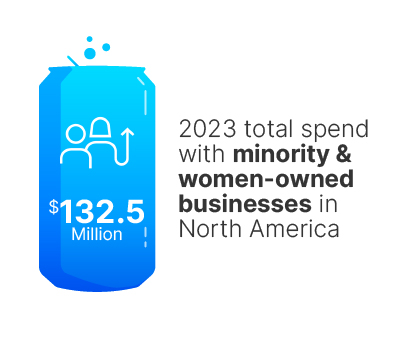
Building a strong network of diverse partners is an essential step towards reaching our sustainability goals and creating a stronger and more resilient supply chain. The majority of our MWBE suppliers are information technology, logistics, industrial, facility service or maintenance and repair companies.

Responsible Sourcing Framework
In 2013, Ball introduced its Responsible Sourcing Framework to help eliminate sustainability risks in the supply chain. It is a four-step approach to help build strong, long-term relationships with our suppliers.
The Category Sustainability Profiles primarily serve as a risk filter and describe potential environmental, social and governance (ESG) related risks for aluminum and coatings. We generate the profiles based on our extensive experience with life cycle assessments, industry standards (such as ASI), and media and stakeholder screening. They list high-risk countries because certain ESG risks, like human rights abuses or climate change impacts, are more prevalent in certain regions of the world.
If a supplier scores below expectations, we jointly develop a Continuous Improvement plan. By developing and approving cooperative programs and timetables, both partners can be successful for the long term. Ball may terminate business relations if a supplier violates a fundamental aspect of our requirements and is unwilling to change.
With our Onboarding Requirements, we communicate and align the way our suppliers consider ESG aspects, and aim to receive written confirmation that responsible business practices are maintained throughout our supply chain. This way, we also ensure that our suppliers abide by all applicable laws and regulations.
For example, we require our suppliers to comply with Ball's Global Supplier Code of Conduct. The principles were developed with input from key customers, suppliers and socially responsible investment analysts, and require that our suppliers certify and demonstrate compliance with them. They cover employment practices, human rights, environment, health and safety, antitrust, bribery and corruption. During the reporting period, Ball provided this document to suppliers and incorporated the principles as part of all new contractual relationships.
New contracts also include clauses on human trafficking. Our form supplier agreements require vendors to provide conflict minerals certifications. Ball’s Conflict Minerals Policy includes information on how we support laws related to ending the violence and human rights violations in the mining of certain minerals in the Democratic Republic of the Congo and surrounding countries. Our Conflict Minerals Report for the year ended December 31, 2021, details the due diligence we have performed as required in Section 1502 of the Dodd-Frank Wall Street Reform and Consumer Protection Act.
Supplier Sustainability Profiles are based on media screening, direct dialogue with suppliers and a sustainability self-assessment questionnaire, which we rolled out globally during the reporting period. The 18 questions, covering recycled content, greenhouse gas emissions, greenhouse gas targets, water usage and ASI. In 2022, we achieved a 100% response rate from aluminum suppliers